
After studying math with her mom, the two walked the field searching for Javin’s lost shoe. Seal’s dad arrived home well before they gave up. They returned to the house, holding hands. “We can try again tomorrow,” her mom said.

This time of year her dad spent more time at the college preparing the curriculum for the new semester. But he still needed to tend the fields, run tests and record observations too. He’d find the swath of broken stalks, the work of Seal and Javin, and he hoped this meant Seal finally emerged from her shell.

He finally finished his day drenched in sweat, exhausted, and in need of a shower. Her dad always ran the water cold and took fewer than five minutes to wash off. It reminded him of bathing in a stream during his teen years.

 Seal waited in the family den reading. Her mom retrieved Paintchip. “I’ll do my best to repair her.”

“Thank you, Mom. I love you.” 

“I love you, Seal.” Her mom picked at the white stuffing poking from the doll’s head as she left the room.

Her parents were Oglala Lakota. They met while students in high school, then attended the same small tribal technical college that he taught at now. He kissed his wife as she sewed in the kitchen before heading into the den.

Cheap faux wood panels covered the walls and framed the drop ceiling, stained from water leaks over the years. Old books gave off a musty smell mixed with the sage from Mrs. Kipp’s weekly ritual to clear the air.

An old encyclopedia set dominated the main bookshelf. Her father had rescued the old leather set after the college replaced them with a newer donation. He often left a volume open to a page on his desk, earmarked for Seal to read, picking an outdated entry and asking her to update it. It required her to struggle with their slow internet or go to the library. The family computer was as old as the encyclopedia set. The only rule was she could not use Wikipedia.

“Hi Daddy.”

He gave her a big hug. “How is my Seal doing today?” he asked.

“Okay, I guess. I said a prayer for Beth and Mom and you. I thought about the sunflower harvest, and I was thinking about the sunflowers, like, when will their heads start turning brown? And a cloud reminded me of a white buffalo.” Clouds often reminded Seal of the animals. “And then I punched Javin like he deserved.”

“I saw you two knocked over a bunch of sunflowers today.”

“That’s why he deserved to be punched.” She did not mention Javin also stole Paintchip.

“Can’t you two play broom ball instead of chasing each other around like angry geese?”

“Not when he is jerky.”

He paused for a long time and Seal remained quiet until he spoke again.

“I have a new story for you today, would you like to hear it?”

For the past few years, Seal’s father taught her new stories of the Lakota. Seal paid close attention and often remembered them well enough that she could re-tell them.

Before he started teaching her about the Lakota, he only read the Wašíču bedtime stories. Wašíču, the Lakota name for the Europeans, or outsiders, could be negative or positive. Some thought it a mean word, but a person’s own actions brought its true meaning. If you acted poorly, it was an insult. If you were fair, it was not.

Her father used to read her Babar, The Little Prince, and Curious George. These gave way to older kids’ books like The Chronicles of Narnia, Matilda, The Wonderful Wizard of Oz and even the first Harry Potter novel. Once Beth turned three, Seal got a second helping as he read them again. But after a few years, Beth changed everything.

While their dad read the first Oz book, Beth asked, “Daddy, why aren’t there darker people in the stories you read to us?” She wasn’t wrong. None of the people had darker skin and eyes and hair. People lived in giant cities or across the ocean or, this time, on a farm in Kansas.

“Why aren’t the stories about farms in South Dakota?” Their father did not have an answer.

Later, when Beth and Seal sat in their room, Beth told Seal how she liked the Oz movie better. “In the movie, the slippers are glittery red. In the book they’re just silver”

“I like the Tin Man in the book. He’s strong,” Seal said. “They’re all stronger in the book.”

“I don’t like him at all” Beth said, her eyes widened. “He killed a pack of wolves in the book. Wolves aren’t bad. He’s nice in the movie. I like when he cries and gets stuck.” Beth moved her arms like a robot and pretended they seized up, laughing at her own imitation. She made squeaking sounds with her closed mouth until Seal pretended to oil her.

Beth continued, “in the movie Dorothy kills the witch. In the books, she let her friends get locked up and she helped the witch.”

“Against her will,” Seal corrected.

Beth shifted the subject. “Do you think Daddy is mad at me?”

“Why do you ask that?” 

“Cause I wanted stories about people like us.”

“Nah, dad likes a challenge. He’d get bored otherwise.”

They laughed together. Their dad never allowed himself to get bored.

“Daddy is funny,” Beth said.

After their bedtime, their dad thought about his daughter’s question. The next night, he had an answer: a short print out of a story from the library. He also tossed the Wizard of Oz Books. He learned that L. Frank Baum hated the Lakota and the monkeys were a racist interpretation of them. “Can you believe it,” Seal overheard him tell her mom, “I’ve been reading these stories forever, and I never knew. Imagine, they name Kansas after us and the best they can do is turn us into monkeys.”

“That’s typical. Blame human nature,”

“I’ll blame L Frank Baum.” He wrapped up the books in the garbage and carried them to the outside bin. He blamed himself for not knowing better.

The first story he read to them was about Iktomi, the Spider trickster. The story reminded Seal of Javin. It’s good Iktomi, already clever enough, didn’t have explosives!

Without Beth questioning her dad, Seal would know little about the Lakota and their history. Their dad assured them he would teach them better, and he had.

“Seal?” Her dad prodded her as she stared blankly at the wall.

“I’m ready daddy, please tell me your story.” Maybe he found another Iktomi story. There were endless stories about the spider trickster.

“I found a good one today. Brand new!” He grinned and recounted the story of the Earth Mother and The Wind.

*** 

Before humans walked the earth, there were only the elements and the bare land. Mountains rose, rivers roared, snow fell and melted, but no living creatures tread upon the ground. The mother of the earth wandered over it all. She wore brown and gray clothing. She was alone and lonely. She wanted company as she roamed where only the tough grass and rough shrubs survived. But they were dull and colorless and did not talk to her.

During her travels, the mother of the earth would sink to her knees and place her fingers above the ground. She conjured an image in her mind, and out would grow a tiny green sprout. Its first tendril curled in a bow to her before it pushed upwards. It grew two leaves, then four, then six, and as the top leaves grew larger, the older bottom leaves shriveled and fell, having done their duty to feed the young plantling. Soon it grew above the outstretched hands of the mother and formed a little head. It tickled the very tip of her chin as she watched over it. Night after night, in rain and in bright sun, the Mother stayed with her creation to guide it.

Once the plant’s head became the size of a baby’s fist, it stopped growing upwards, putting all its energy into creating a flower. The first plant she made honored the sun. Its petals popped out of the growing head bright yellow. The vivid petals settled into a starburst pattern, with an eye in the middle so they could see the Earth Mother and greet her. With the first flower grown, a yellow dot sprouted on the Mother’s plain robes.

The Mother spent years planting her flowers in assorted colors and in time her clothing became bright with them. The flowers she grew were blue like the skies, white like the snow, red like the soil. She created new colors never seen. The land became covered in purple, orange, and pink dots. After a long time, the Mother re-visited her first child. It lay broken on its side, dead and brown. She felt devastated by the loss. She noticed the first bright yellow decoration on her clothing had also faded. The flower’s roots had been pulled from the ground. She raced to visit all her flower children. They were broken and dead, too. She knew immediately what had caused it. The Wind.

The Wind, old like the Mother, scudded across the earth, angry. It tore through mountains and caused the water to carve giant scars, called canyons, into the earth. It made the snow and rain angrier, so they needled the skin of the Mother when they fell on her. The Wind was too fast to catch, slipping through all the cages the Mother devised.

The old Mother kept trying, growing more flowers and giving them strong roots which clung deep underground. But she found these broken at the ground’s edge. The roots held, but the rest lay on their side like a bowling pin.

“Please,” she pleaded with The Wind, “please let me keep my children to cure my loneliness.” The Wind whipped by her head and gave no answer beyond causing her long hair to whip into her face, stinging her. The Wind had no eyes. It only felt objects it touched. It carried pieces of dust, droplets of water, and the salty smell of a distant ocean on its back. The Earth Mother thought upon the nature of her adversary, trying to think of a way to beat it. She realized the wind could not be beaten any more than the sun or the sky. It was of the same firmament as her.

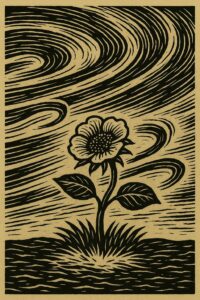
Finally, the Mother had an idea. She kneeled upon the soil and spread her hands. Out grew the sprout, the leaves, and before the head emerged, she let her creation grow past her chin and up to her nose. The plant spread itself into a deep pink flower with a yellow eye. She exhaled through her nose with her powers upon her new child. She held her breath and waited four sunsets before breathing in through her nose once more. A sweet, beautiful smell met her unlike any the world knew before.

The Mother left the flower to grow and sat far enough away to keep it in view. Before long, the Wind came upon it. It roared in from the north, suddenly stopping before rolling over the flower. A strange scent it had never encountered before stuck to it. But an angry creature cannot be quelled easily. It approached from the south as fast as it could. It tried again from the east, and finally from the west, determined to bowl over the flower. But each time, a welcoming fragrance greeted The Wind. It could not bear to cross over the flower. The Wind spent days next to the flower and felt calm for the first time. It sped its way to the Mother.

“What did you do?” it asked her. The Wind smelled fully of the flower now.

“I gave you a present. You cannot see the beauty of my flower, but you can smell it. Do you like it?”

“Very much, Earth Mother. Thank you.”

“I will give you another gift if you come back in a few months.” The Wind bowed to her and breezed through her hair, gently, leaving it scented.

Months later, The Wind came back and found the flower grown into a great bush, covered in flowers. Some were old and dying, as flowers do not live long lives. The Wind carried them and their dried berries to other places where they would grow into new flowering bushes.

The Mother of the Earth and The Wind continued to plant her flowers across the land until her clothing became covered brightly in all the different colors. Both found their happiness and were not lonely again.

***

“I liked that one,” Seal said.

Her father nodded. Beth would have enjoyed the story too, she thought.

“Do you know what we call the flower she planted?”

She knew this. “The Prairie Rose, state flower of North Dakota, but also found in South Dakota.”

“Right. What is its scientific name?” Seal shrugged.

“It is the Rosa Arkansana. It blooms in June and can grow to be white or pink, or some mixture. It is used to color food, to feed bees, in medicines and it is said to relieve stress if you eat it. It is high in vitamin C. Our people call it the uŋžíŋžiŋtka hú.” Her father’s tongue stumbled over the words. He was not raised to understand the Lakota language well, but he managed.

“Is it like the sunflower, the chili, or the dandelion?” he asked.

Seal thought about this, and he allowed her time. “The sunflower,” she answered.

“Why?”

“The sunflower offers seeds to birds, but it makes enough that they fall to the earth to make more.”

“That’s mostly right,” her dad said. “The Prairie Rose creates hips. They can fall to the ground like the sunflower and grow, but like chiles, birds also eat them and they spread that way. Only the dandelion creates seeds that float on the wind. As you can see, the story doesn’t quite match the real world. Stories are often like that.”

Seal nodded.

“Now think how the story might be different if instead of The Wind, a water spirit came to drown the flowers. What could the Earth Mother do then to please this water spirit?” This would be Seal’s new weekly assignment. Somehow, the Lakota story had become a biology lesson. Her dad was sneaky.

 With the lesson finished, Seal hugged and kissed him and left to find her mom. Paintchip, now fixed and whole again, waited for her.

“Thank you, Mom.”

Her mom ran her fingers through Seal’s hair. It was soft, but could use a good scrubbing. “Good night. I love you, Seal.” Seal spent the rest of her time reading stories to Paintchip. The buckskin doll no longer had stuffing coming from its head. Maybe her mom was getting better at sewing.

As she read to Paintchip, she knew she had a problem. Seal started school soon and they would make her leave Paintchip at home. She did not want to leave her behind, and the worry spread into her dreams. Seal was back to being in a bad mood when she woke up the next morning.